Over one-in-five Edinburgh children starting school deferred a year. More than 90% of eligible ESS families have already exercised their legal right to remain in Kindergarten, ahead of Saturday's deadline. 
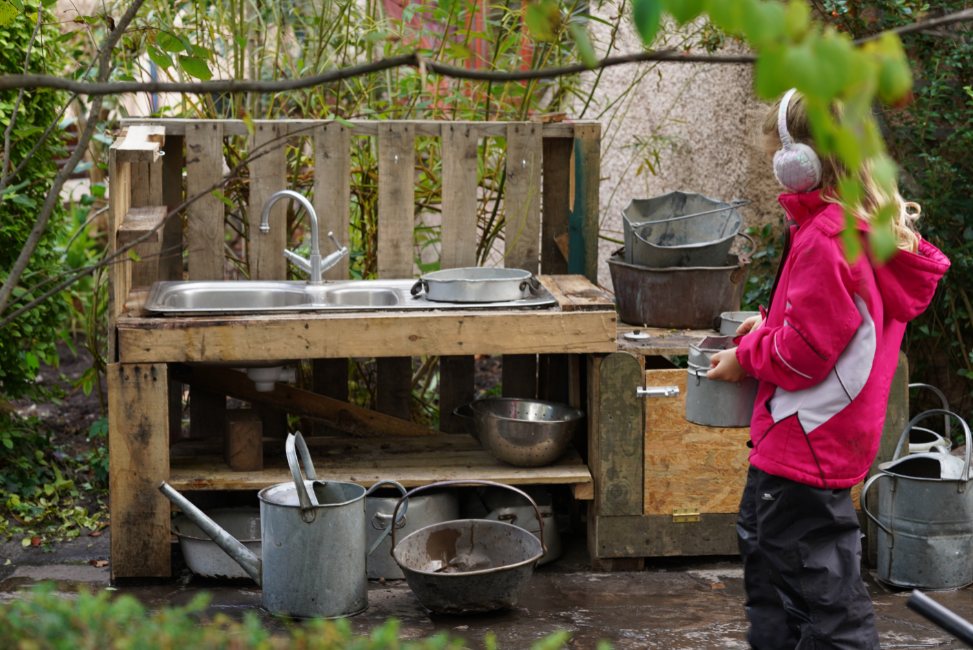
A young girl playig at a mud kitchen outdoors, in kindergarten nursery setting, carrying water in pot. Alternative envirnment for 4yo instead of P1 classroom, excercising statutory right to defer entry to P1
Scotland is an educational outlier, having one of the youngest school starting ages in the world, with pupils beginning their school career from as young as 4½ yo. Yet, a paradigm shift in attitudes has been occurring since the pandemic.
 
All children who have yet to celebrate their birthday with a five-candled cake by the first day of P1 are entitled to an extra year of Early Learning and Childcare, following a law change in 2023 that brought an end to the decades-long birthday discrimination.
 
Since then, the number of children starting formal education at least a year later has increased to over a fifth of each subsequent year's cohort. In this current academic year, 894 pupils across the Capital are 'deferred' children were supported in their decision to favour the learning environment of a Kindergarten or nursery over a classroom last session, making them account for roughly 23% of the 3,892 pupils who started P1 in August.* 
 
822 pupils who were also eligible to start their school career this academic year enacted their statutory right not to. Most will join P1 in a few months time, meaning the upcoming P1s across the nation will have children aged 4.5-6yo in one cohort.      
 

ESS, in collaboration with Give The Time, successfully campaigned to bring an end to the birthday discrimination experienced by thousands of 4yo across Scotland, which relied on the discretion of individual Councils to grant an application for 4yo with a birthday in the last five months of the year. Others were discouraged by their local authority’s reputation for refusing a high percentage of applications. Multiple FOI request by the grassroots organisation revealed that between 2015 – 2019, 500 families submitted discretionary applications to Edinburgh Council. Just under half (234 requests) were rejected. More families were put off from even applying by an application process described as: 

‘degrading, difficult and insensitive, forcing parents to list their child’s ‘deficits’ in an effort to provide a well-evidenced and convincing request, requiring a support statement from a professional, in spite of being the prime caregiver and the empowered party by law’ put many off.'

(Give Them Time).
 
 
A record number of Edinburgh families with a 4yo due to start primary school in the pivotal 2023/24 academic year chose to postpone, a further FOI reveals. 4,030 pupils started P1 and 806 eligible children deferred, most* joining the 3,933 P1ers enrolling in 2024/25 (~20.5%).
 
Figures for the most recent round of applications for a further funded ELC year and numbers starting school are not yet available. The Council close the application process at the end of February for 4yo with a birthday falling in mid-August to December 2021 and January-February 2022. All bar one P1-aged ESS pupil has opted to stay on in Kindergarten in 2026/27.
 
The Council confirms there is no plan to remove the need to apply. The national debate regarding raising the school age from four/five to seven, sparked by a milestone successful SNP motion in 2022, continues to gain traction. 
 
*These figures are based on deferred children then enrolling at their local authority primary in Edinburgh; and not adjusted for the handful attending Treetops Kindergarten at ESS, those who move out of the Capital, or enrol at an alternative independent. Fee-paying primary pupils were estimated in 2023 to be just 2.4% nationally, shrinking by 13.3% in the years since VAT was levied on tuition fees, though the number is considered much higher in the Capital. (A pre-covid report published in December 2018 put the number at around 10% of primary-aged children attending one of the ten Edinburgh independent schools, including ESS).

The increase was fuelled in part by a greater awareness around Scotland’s extraordinarily early school starting age, highlighted in a short documentary released free on YouTube, Facebook, Instagram and its own website, Now We Are Six.  (https://pressreleases.responsesource.com/news/102596/capital-set-for-twofold-increase-in-mid-august-december-born-year-olds/

The following year, 14.4% (1583 of ~10,990 eligible P1-aged children in Edinburgh) postponed the classroom, desks and timetable. For this current academic year, 19.4% (1,526 of ~7,875 eligible P1s) did the same. That's one in every five - double the number three years ago.  
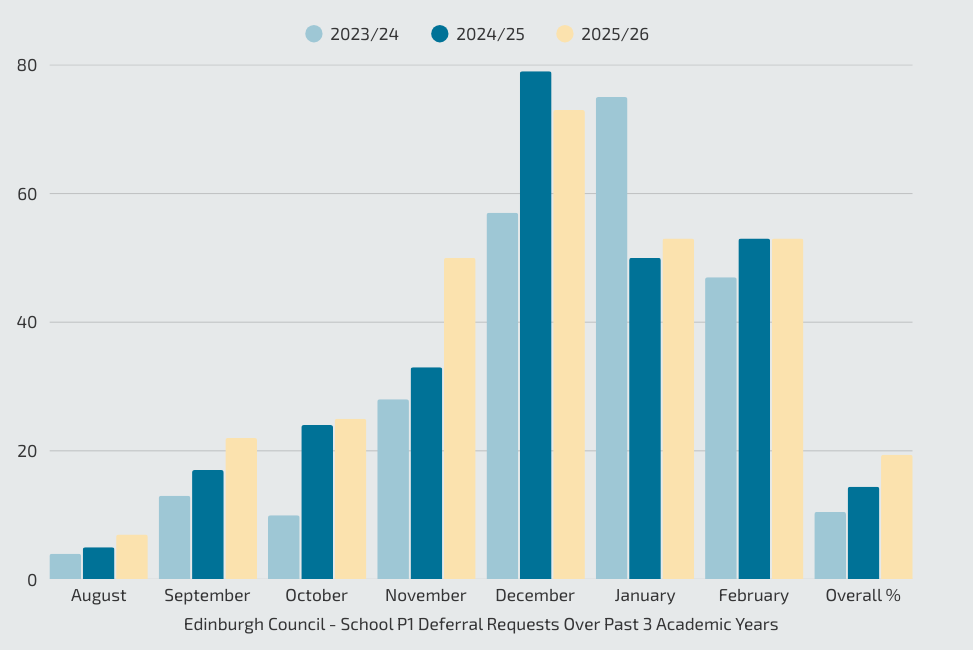
 
The figures over each of the three years show a pronounced gradient by month of birth, with deferral far more common among younger children within the cohort. A whooping 79% of children born in the last month of the year deferred to this current academic year. 

All children whose 5th birthday falls between 10th August 2021 and 28th February 2022 (for August 2026 entry) are entitled to remain in a Kindergarten setting for a further year. Parents must still apply to the City of Edinburgh Council to 'defer'. The application process opened up in November, giving parents and carers four months to complete the short online form. The deadline is this Saturday, 28 February 2026. 

Why defer? 
Almost all nations start school at age 6 or older. Made by an award-winning education filmmaker, Now We Are Six puts a kilt on Saskia Anley-Mccallum’s work, which looks at why Scotland has failed to turn the play-based principles of CfE's Early Level (ages 3 - 7) into practice.

Waldorf is the only education movement available in the capital where formal education starts in a pupil’s seventh year, starting Class 1 age 6yo at the end of August. It is no wonder then that each of our five kindergartens are currently full with waiting lists.  

ESS is also one of only two independent schools in Edinburgh offering parents ELC places in its kindergarten for children of mixed ages from 2-5 years old.

Here, the rhythm of daily life is simple and unhurried without the notions of ‘achievement’,’ success’, or ‘failure’. 
This holistic approach weaves through the Lower School years of school, which is screen-free until secondary in the classroom, extending to break and lunch times too through the gold-standard smartphone-free policy that keeps phones (for those few pupils who have them) at home through Classes 5 and below.